Leveraging Geopolitical Risks for Competitive Advantage
Discover how companies can transform geopolitical risks into competitive advantages. This study explores risk management strategies that enable firms to anticipate crises, strengthen resilience, and leverage opportunities amid wars, sanctions, and trade disputes.
5/24/20265 min read


How can companies turn geopolitical risk into a competitive advantage?
Izan Araújo is a political geographer and geopolitical risk analyst. He holds a master’s degree in Human Geography from the University of São Paulo, Brazil, where his research focused on political geography. He is also a researcher at the Laboratory of Geopolitics, International Relations, and Antisystemic Movements (LabGRIMA) at the Federal University of Pelotas, Brazil.
Introduction
How can companies transform geopolitical risks into competitive advantages in a world marked by wars, sanctions, trade disputes, and supply chain instability?
This question has become central for executives, investors, and risk managers, as global events increasingly affect not only governments but also corporate costs, suppliers, markets, reputation, and strategic decision-making. In recent years, geopolitical risk has expanded beyond diplomacy and international security to become a core element of the corporate agenda. As a result, global firms are directly impacted by factors such as economic sanctions, regional conflicts, great power rivalry, logistical disruptions, trade tariffs, and disputes over critical minerals. According to the World Economic Forum’s Global Risks Report 2026, leaders must navigate both immediate crises and long-term risks in an increasingly turbulent environment.
Geopolitical risk can be transformed into a competitive advantage when companies anticipate threats before competitors, adapt their supply chains with greater resilience, and use strategic intelligence to make better decisions in an uncertain global landscape. To begin with, firms that effectively anticipate geopolitical threats can position themselves ahead of competitors.
1. Anticipating Geopolitical Threats
First of all, companies transform geopolitical risks into competitive advantages when they develop the ability to anticipate threats. Instead of reacting only after a crisis, better-prepared organizations monitor geopolitical, economic, and regulatory signals. For example, tensions in the Middle East, sanctions against Chinese companies, or blockages of maritime routes may indicate future increases in costs, logistical delays, or market restrictions. The case of Hengli, a major Chinese petrochemical company affected by U.S. sanctions, shows how critical business processes, including contracts, investments, supply chains, and international operations, can be impacted by geoeconomic confrontation, such as sanctions and trade restrictions. Thus, firms that track these signals can adjust their contracts, inventories, insurance, and suppliers in advance.
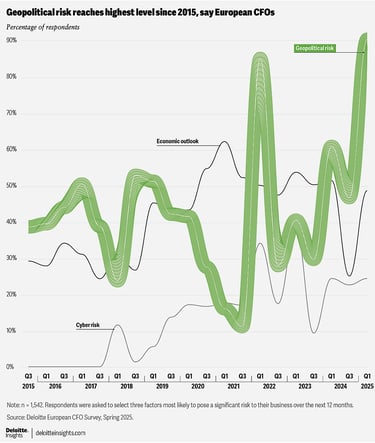
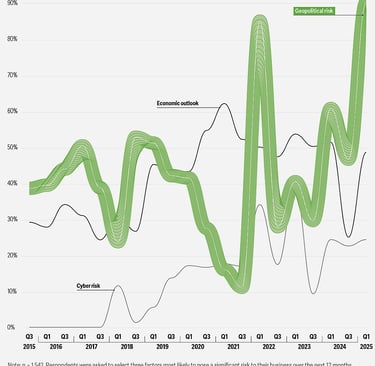
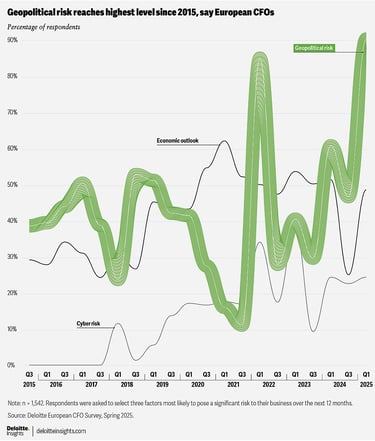
The graph above shows that geopolitical risk was ranked as the top external concern by European CFOs in 2025. According to Deloitte, geopolitics was identified by 90% of respondents as one of the three most significant business risks, marking the highest level since 2015. This suggests that firms increasingly view geopolitics as a direct threat to their operations, costs, supply chains, and strategic planning. The graph highlights how geopolitical tensions shape corporate decision-making and reinforces the need for proactive risk management in an uncertain global landscape to ensure business continuity. In addition to anticipating threats, companies can strengthen their competitive positions by building more resilient supply chains.
2. Resilience in Supply Chains
Second, competitive advantage emerges when a company transforms its supply chain into a resilient structure. Excessive dependence on a single country, port, supplier, or logistical route increases operational vulnerabilities. Therefore, competitive companies diversify their suppliers, create strategic inventories, adopt nearshoring, revise trade routes, and develop contingency plans. According to an analysis by Thomson Reuters, supply chain management was considered a strategic priority by 68% of international trade professionals in 2026, almost double the percentage of the previous year. These data show that supply chain management is no longer only an operational function but has become part of the corporate strategy.
Source: Deloitte. (2025). Board Oversight of Geopolitical Risk.
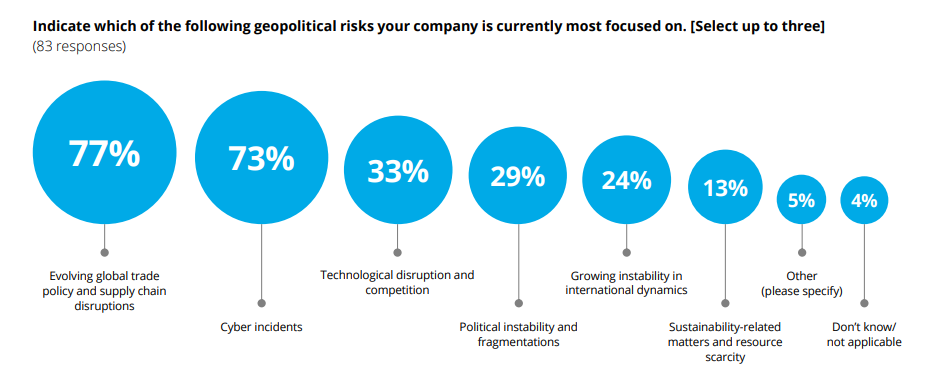
The graph above, from Deloitte’s Board Oversight of Geopolitical Risk report, shows that several geopolitical risks are being monitored by companies simultaneously, with global trade policy and supply chain disruptions ranking at the top at 77%. Cyber incidents were ranked as the second concern, followed by technological disruption, political instability, and growing uncertainty in international dynamics. This distribution suggests that firms no longer see geopolitical risk as a single external shock but as a broad set of interconnected threats that affect operations, technology, and resilience.
3. Geopolitical Intelligence in Senior Management
Finally, companies gain an advantage when they integrate geopolitical risks into senior management decision-making processes. Boards of directors and executives must assess how global events may affect revenue, costs, reputation, market access, and operational continuity. According to Deloitte, operations, supply chains, and market access can be disrupted by geopolitical events, requiring greater oversight from the corporate boards. In this sense, geopolitical risk analysis can support decisions regarding international expansion, investments, mergers, acquisitions, suppliers, and entry into new markets. Ultimately, companies that treat geopolitical risks as strategic inputs are better positioned to make informed decisions and strengthen their competitive advantage.
Moreover, boards of directors and executives must evaluate how geopolitical developments influence revenues, costs, and long-term stability. For example, the risks and opportunities of operating in a specific country or region can be changed by sanctions, trade restrictions, regional conflicts and political instability. Companies that monitor these developments are better able to adapt their strategies before crises directly affect their operations. In this sense, geopolitical intelligence should not be treated merely as an external report or an occasional analysis. Instead, it should be part of corporate planning, board discussions, and executive decision-making. Therefore, incorporating geopolitical risk into executive planning allows firms to respond strategically to uncertainty and strengthen their competitive positions.
Conclusion
In summary, this essay argues that geopolitical risk can be transformed into a competitive advantage when it is no longer treated as an external threat but is incorporated as a tool of business strategy. The first advantage comes from anticipating threats, the second from building more resilient supply chains, and the third from integrating geopolitical intelligence into executive decision-making.
In practical terms, I recommend that permanent routines for geopolitical monitoring, risk mapping, scenario planning, and executive reporting be institutionalized within companies. The trend is that, in the coming years, companies capable of quickly interpreting geopolitical risks will have greater capacity to protect their assets, identify opportunities, and compete in unstable markets.
Suggested Reading
To deepen the analysis of geopolitical risk and business strategy, I recommend Geopolitics of the World System by Saul Bernard Cohen and Geostrategy by Design by Courtney Rickert McCaffrey, Witold J. Henisz, and Oliver Jones. Cohen’s book helps readers understand the geopolitical structure of the world system, while Geostrategy by Design offers a practical approach to managing geopolitical risk in business.
Disclaimer:
All views, positions, and conclusions expressed in this publication should be understood to be solely those of the author.
Disclosure: As an Amazon Associate, if you buy through the links above, I may earn a commission at no extra cost to you.
References
Deloitte. (2025). CFOs in Europe ranked geopolitical risk highly. Available at: https://www.deloitte.com/us/en/insights/topics/business-strategy-growth/geopolitical-risk-cfos-europe.html
Deloitte. (2025). Board Oversight of Geopolitical Risk. Available at: https://www.deloitte.com/us/en/programs/center-for-board-effectiveness/articles/board-oversight-of-geopolitical-risk.html
Reuters. (2026, May 22). Hengli, China’s Silk-to-Petrochemicals Empire, Faces the Chill of US Sanctions. Available at: https://www.reuters.com/business/energy/hengli-chinas-silk-to-petrochemicals-empire-faces-chill-us-sanctions-2026-05-22/
Thomson Reuters. (2026, February 12). The 2026 supply chain challenge: Global trade disruptions. Available at: https://tax.thomsonreuters.com/blog/2026s-supply-chain-challenge-confronting-complexity-and-disruption-in-global-trade-tri/
World Economic Forum. (2026). Global Risks Report 2026. Available at: https://www.weforum.org/publications/global-risks-report-2026/